
Ever wondered while visiting an aquarium? Why are the 62,000 cubic meter whale shark tank at Chimelong Zhuhai and the 17-meter-long Poseidon Ocean Tunnel in Harbin uniformly constructed with acrylic instead of glass? Three hard-core facts that challenge conventional wisdom!
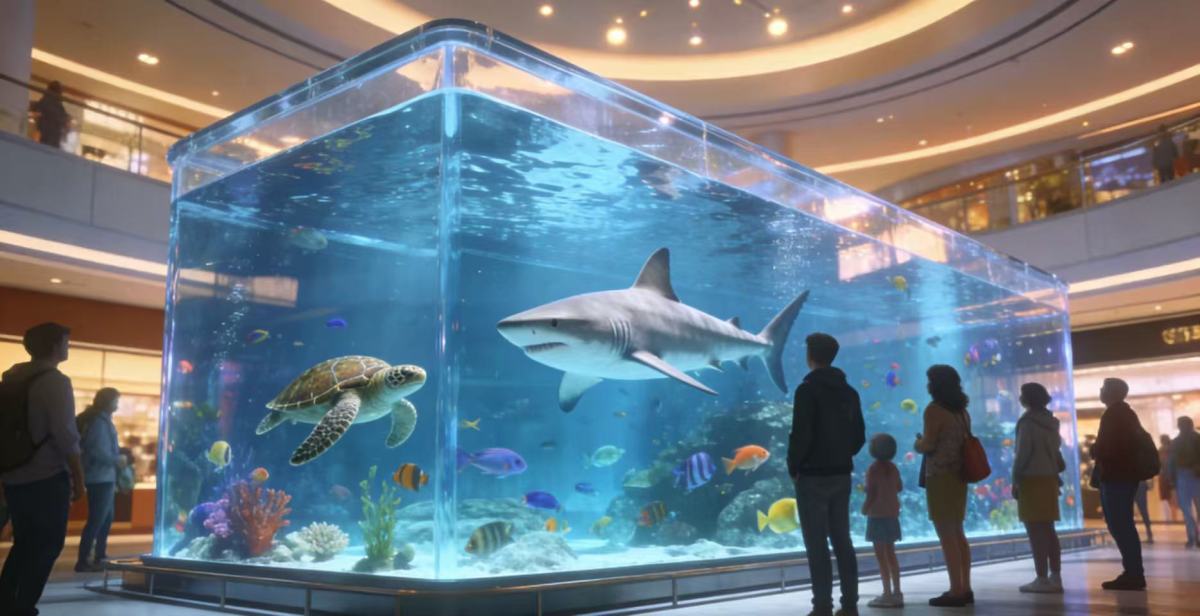
Safety Performance: Impact resistance is 8-10 times stronger than glass! Large aquariums often contain hundreds of tons of water. As a brittle material, glass can crack and shatter even with minor cracks (a Wuhan aquarium once suffered a glass tank rupture caused by visitors 'slapping, resulting in repair costs of 160,000 yuan). In contrast, acrylic's tough structure actively dissipates water pressure, remaining stable at depths of 10 meters. Even when impacted, it only undergoes controlled deformation, eliminating catastrophic leakage risks.
Form knows no bounds: While glass is confined to flat surfaces, acrylic glass unlocks boundless creativity! Through precision hot-bending technology, it can craft complex structures like cylinders, curves, lotus-shaped tanks, and egg-shaped containers, even creating 360-degree viewing walls and underwater tunnels. The 45 uniquely shaped tanks at Beihai Ocean Window and the mermaid performance tank at Guangdong Puning Commercial City stand as testament to acrylic's remarkable malleability, immersing viewers in the awe-inspiring experience of being "under the sea."
Engineering-grade compatibility: Reduces weight by half for safer installation! Acrylic has only 50% the density of glass, significantly lowering structural load-bearing pressure—ideal for complex environments like mall atriums and high-rise buildings. Projects such as a 15-meter internet-famous marine aquarium in a Shenzhen luxury residence and an outdoor fish pond at Nanjing Ginkgo Lake Amusement Park achieved efficient installation thanks to acrylic's lightweight advantage. With 92% light transmittance surpassing conventional glass, marine life colors appear more vivid and lifelike.
From the perspective of materials science, acrylic not only addresses the safety hazards and modeling limitations of glass in large-scale aquatic engineering projects, but also boasts an exceptionally long service life of 10-20 years. Additionally, scratches can be professionally polished and repaired, offering superior lifecycle cost advantages. Whether for aquariums, commercial exhibitions, or high-end spatial installations, acrylic has long been recognized as the "only solution" in the engineering field!
Conclusion: Glass is an option for small household tanks, but for large-scale water projects? Acrylic is the standard answer!
Navigation
Send Us A Message
CHAIDONG
Professional generator set manufacturer
24/7 before-sales and after-sales services
Comprehensive technical support